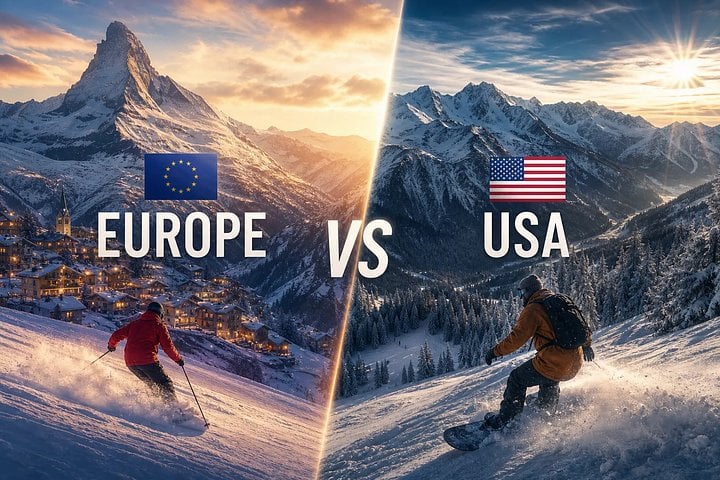
Every season, American skiers face the same genuine dilemma. Domestic resort prices keep climbing — peak-day tickets at Vail now reach $374 and Park City topped $351 in 2025/26 — while skiing in the Alps looks increasingly appealing but feels complicated and expensive to plan from scratch. When you search "best skiing in Europe vs USA," most articles land on "both are great" and leave you no closer to a decision.
This comparison is different. The Adventoured team has skied on both sides of the Atlantic, and we've developed guided programs in the Italian Alps because we know what American skiers need from a European mountain. What follows is an honest breakdown across five pillars: snow, terrain, cost, culture, and logistics. By the end, you'll have a clear answer for your specific situation.
Snow Quality and Mountain Terrain: Alps vs Western US Resorts
Snow quality is usually the first question skiers ask, and the honest answer depends on what you mean by quality.
European Alpine ski resorts above 1,800 to 2,000 meters offer something genuinely different from most US destinations: reliable snow coverage even in shoulder months. The French Alps, Swiss Alps, and the Italian Alps all benefit from high-altitude terrain that keeps snow intact through warmer spells. The Dolomites — a UNESCO World Heritage mountain environment in northeastern Italy and one of the premier ski holiday destinations in Europe — add exceptional terrain variety to that reliability, with linked circuits, north-facing couloirs, and glacier zones that hold snow far into spring.
Where US Resorts Hit Back: Raw Snowfall Volume
Jackson Hole averages roughly 10.7 meters of snowfall annually, and Alta in Utah competes in the same tier. Western resorts in Utah and Wyoming deliver a powder-day frequency that the Alps, for all their virtues, simply don't match on average. The Italian Alps specifically are not a powder destination in the Utah sense — they reward a different kind of skier entirely.
The honest summary: Europe wins on snow reliability at altitude and terrain variety; US western resorts win on total snowfall and powder-day frequency. Both are genuinely excellent, just excellent in different ways.
What Skiing in the Alps Actually Costs vs US Resorts in 2026/27
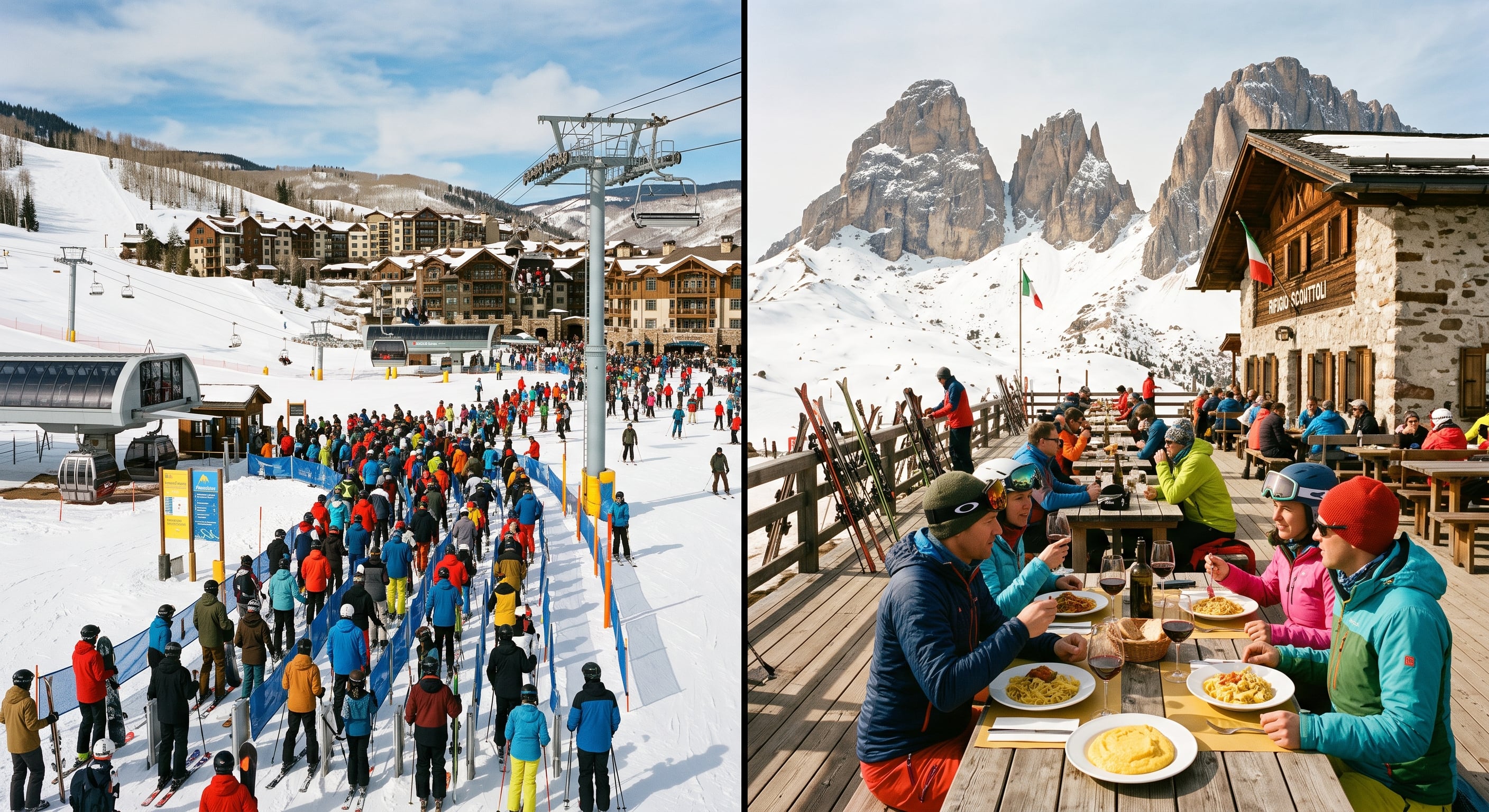
Lift pass pricing in 2026 tells a revealing story about where the value equation is shifting.
Destination Day ticket (approx.)
Vail (peak day) $374
Park City (peak day) $351
French Alps (premium resorts) €75–86
Swiss Alps €80–90
Italian Alps – Alta Badia €77
Italian Alps – Val Gardena €80
Austrian Tirol €60–75
Season pass products like the Epic Pass ($1,119 for adults) and Ikon Pass ($1,329) offer better domestic value, but only if you ski enough days to justify the upfront cost. European ski holiday day tickets look genuinely competitive by comparison, and multi-day Alpine passes represent strong value when stacked against US peak-day pricing.
The Total Trip Budget: Where the Real Comparison Lives
The total trip budget tells a different story. A domestic US ski week — airfare, lodging, lift tickets, and daily expenses — typically runs $1,000 to $1,500 per person. A ski holiday in Europe runs $4,000 to $8,000 per person once you factor in a transatlantic flight ($700 to $1,500 alone), accommodation, transfers, and daily costs.
Europe costs more in total. The real question is whether the experience you're buying justifies the difference. For many American skiers who make the trip once and ski with a specialist, it clearly does.
Terrain Variety: Matching the Mountain to Your Ability Level
The answer here splits cleanly by skier profile.
Beginners and intermediates are well served on both continents. In Europe, Val Gardena's wide groomed Sella Ronda circuit is a benchmark for intermediate skiing in the Alps, while La Plagne and Les Arcs offer excellent beginner progression. On the US side, Breckenridge and Keystone earn their reputation for accessible beginner terrain, and Vail or Park City give intermediates room to grow with large amounts of comfortable cruising runs.
European mega-domains offer one advantage that US passes can't fully replicate: the ability to ski across multiple resorts on a single pass, all connected by lifts, within a single valley system. The Dolomiti Superski area links over 1,200 kilometers of marked runs across 12 connected valleys — that geographic scale fundamentally changes what a ski week feels like. You're not returning to the same lift every morning; you're genuinely traveling through mountain geography on skis.
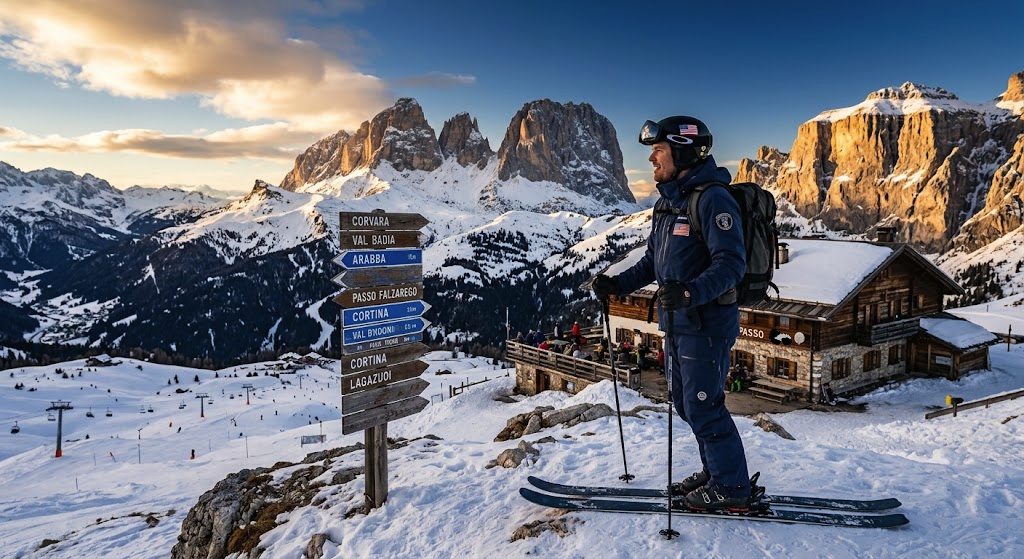
For advanced and off-piste skiers, the comparison is more nuanced. St. Anton has a strong off-piste reputation in Europe, with dense expert terrain across Galzig and Rendl. Verbier and Zermatt are both capable big-mountain destinations. The Italian Alps offer something different: technical, guide-reliant lines through routes like Val Mezdì in the Sella massif, the Marmolada glacier above Arabba, and the legendary Lagazuoi to Armentarola "Hidden Valley" descent. These aren't broad freeride playgrounds in the St. Anton mold — they're specific, scenic, and require local knowledge to ski safely and well.
Après-Ski Culture and the Full Resort Experience
This is where Europe and the US diverge most dramatically, and most travel guides understate how much it matters for a complete ski vacation.
In the Italian Alps, lunch at a rifugio mid-mountain is a ritual, not an option. You ski down to a stone-and-timber mountain hut, sit in the sun, order local wine and pasta, and stay longer than you planned. The mountain day is structured around that pause. Villages like Corvara and Ortisei in the Italian Alps, or Lech in Austria, carry generations of Alpine character that no purpose-built resort can replicate.
US resorts do their version of the ski town experience at a high level. Aspen and Jackson Hole have genuinely world-class restaurant scenes. Park City's Main Street has real charm. Vail Village is well designed for post-ski comfort, and the luxury product across Colorado is excellent.
But cultural authenticity is not something money builds quickly. Many Alpine villages have centuries of history, and that depth is simply a different category of place. If you want the trip to feel like an immersion in a living mountain culture rather than a visit to a ski product, ski holidays in Europe win this comparison decisively.
Logistics from the US: The Honest Practicalities
A domestic US ski trip is logistically simple: book a flight, rent a car, arrive the same day. A European ski holiday adds meaningful layers.
A transatlantic flight from New York to Milan Malpensa runs about eight hours nonstop. From Chicago, plan for nine to ten hours; from Los Angeles, eleven to twelve-plus. After landing at Malpensa, the Italian Alps are another three and a half to five and a half hours by car or private transfer, depending on your target resort. That's a significant travel commitment that requires proper planning to avoid burning your first ski day.
That logistical complexity largely disappears when a specialist manages the trip end-to-end. Adventoured's Alpine ski packages are designed to cover airport pickup from Milan Malpensa, resort transfers, accommodation, equipment rental, and guide coordination. Local mountain guides who live and work in the Alps handle route selection, daily conditions assessment, and off-piste access. Rather than navigating an unfamiliar lift system on day one or sorting equipment rental on arrival, you step off the plane into a trip that's already running.
For many American skiers, that structure makes the difference between a stressful first European trip and a genuinely great one.
Two Italian Alps Ski Packages Worth Knowing About
If you're considering making the jump to skiing in the Alps with proper local support, here's what Adventoured currently offers American skiers:
Dolomites On-Piste Ski Safari — from $5,108/pp A 7-night resort-to-resort adventure moving through Val di Fassa, Val Badia, Val Gardena, and Belluno across the Dolomiti Superski network. Expert local guides handle all logistics, accommodation transitions, and daily route optimization. Includes the legendary Sellaronda circuit and access to over 1,200 kilometers of connected terrain.
Brenta Dolomites Ski Experience — from $2,371/pp A 6-night guided ski safari through the western Italian Alps, moving from Andalo Paganella through Madonna di Campiglio, Folgarida Marilleva, and Pejo. A more intimate introduction to ski holidays in Europe for those wanting the resort-to-resort experience without the scale of the eastern Dolomites network.
Both packages include certified local guides, accommodation, breakfasts and dinners, lift passes, and all transfers during the trip — the all-inclusive structure that eliminates the planning complexity that deters many first-time Alpine visitors.
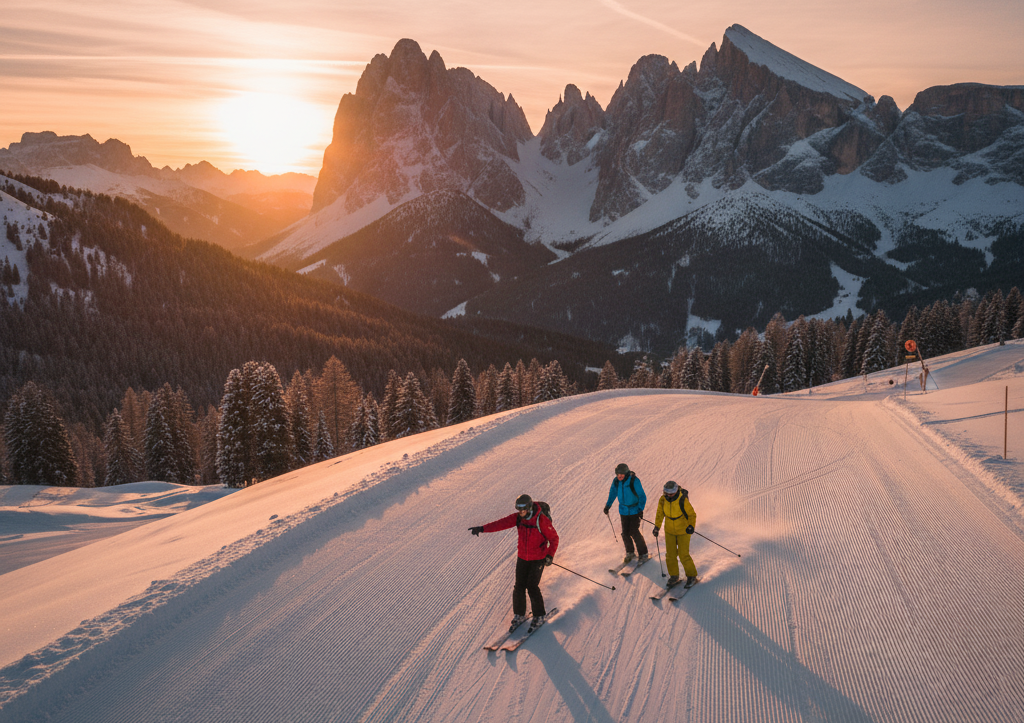
Browse all available Alps ski trips and check current availability at adventoured.com/trips-ski-trips.
Which Skiing Destination Actually Fits Your Priorities
Here is the honest decision framework — the section most comparison articles bury or skip entirely:
Powder volume is the only priority → Utah or Wyoming
Alta, Snowbird, and Jackson Hole are genuinely unmatched for powder-day frequency. If deep untracked snow is your primary objective, the US western resorts win outright.
Beginner or intermediate progression → Breckenridge or Keystone for US; Val Gardena or La Plagne for Europe
Both continents serve developing skiers extremely well. Choose based on budget and whether the cultural dimension matters to you.
Advanced off-piste with guide access → St. Anton or Verbier for broad freeride; Italian Alps for technical scenic lines
The Italian Alps reward skiers who want guide-led access to specific terrain rather than broad freeride playgrounds.
Linked mega-domain skiing with village culture → the Alps, without question
No US destination replicates the experience of skiing across twelve connected valleys over a week, with rifugio lunches and centuries-old villages at every base.
Budget is the primary constraint → domestic US trip
A Colorado or Utah week at $1,000–1,500 per person is exceptional value. The Epic Pass and Ikon Pass holders already have access to world-class terrain without transatlantic cost.
You want a genuinely different ski adventure that stays with you → European ski holidays in the Alps
The cultural depth, terrain variety, and the specific pleasure of skiing through a UNESCO landscape with expert local guides creates a category of experience that domestic skiing, however excellent, doesn't replicate.
Stop Debating, Start Planning
Neither side wins the best skiing in Europe vs USA comparison universally. US western resorts are world-class for powder volume and domestic convenience. The European Alps are unmatched for terrain variety, cultural depth, and the kind of mountain experience that stays with you long after the ski tan fades.
The real decision comes down to what you want from a ski trip. Powder days close to home? Book Colorado or Utah. A genuine Alpine adventure with knowledgeable local guides, linked resort circuits, and rifugio lunches in the Italian mountain sun? Adventoured's team is ready to build your 2026/27 itinerary from scratch.